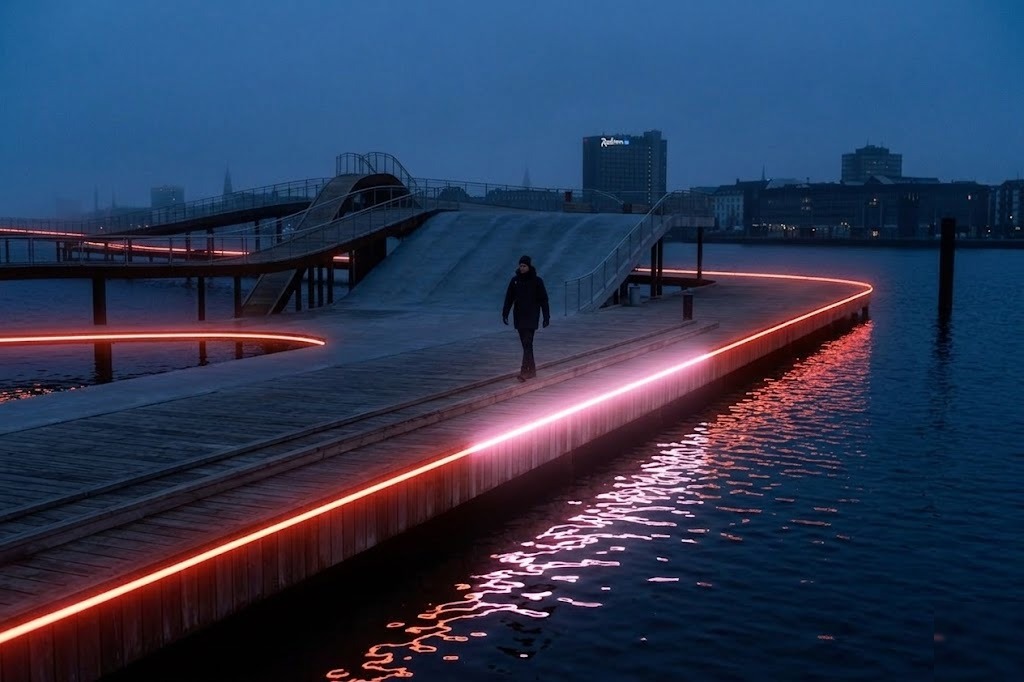
A continuous luminous line along the water-facing edge of Kalvebod Bølge — sixty metres of warm-red light that breathes with the harbour and responds to every footstep.
A continuous luminous line — sixty metres of warm-red light running along the water-facing edge of Kalvebod Bølge. From across the water, a single ribbon glowing on the structure's edge. Beneath it, a diffuse warm reflection on the surface of the harbour itself.
A slow base wave drifts along its length continuously, back and forth — the harbour breathing through the line. The wave responds to the actual harbour: when the tide rises beneath the cantilever, the wave grows; when wind moves through the structure, it modulates the line's rhythm. The piece is never still. It is doing its quiet work even when no one is watching.
When someone walks onto the structure, the line registers them. Their footstep, picked up by accelerometers embedded along the boardwalk, becomes a sharp pulse of brighter, almost-white light that originates at the point their foot landed and travels outward in both directions — a heartbeat shape, propagating. Two people walking from opposite ends see their pulses meet and pass through one another.
For more than a decade I've built systems that make invisible processes legible — real-time data, sensor signals, the running state of distributed software — but always for screens, always indoors, always private. Harbor Heartbeat is the first time I'm reversing that direction: taking what a physical space is already doing and rendering it back, as light, in the place itself.
Kalvebod Bølge is not still. The harbour moves under it. The wood flexes. People walk across it without noticing that the structure registers them. The piece does not decorate the structure; it makes the structure honest about what it has always been doing.
Although Kalvebod Bølge is my preferred location, the installation is flexible: if the festival has another site in mind with similar characteristics — a water-facing public edge of comparable length — the work adapts without compromising the concept.
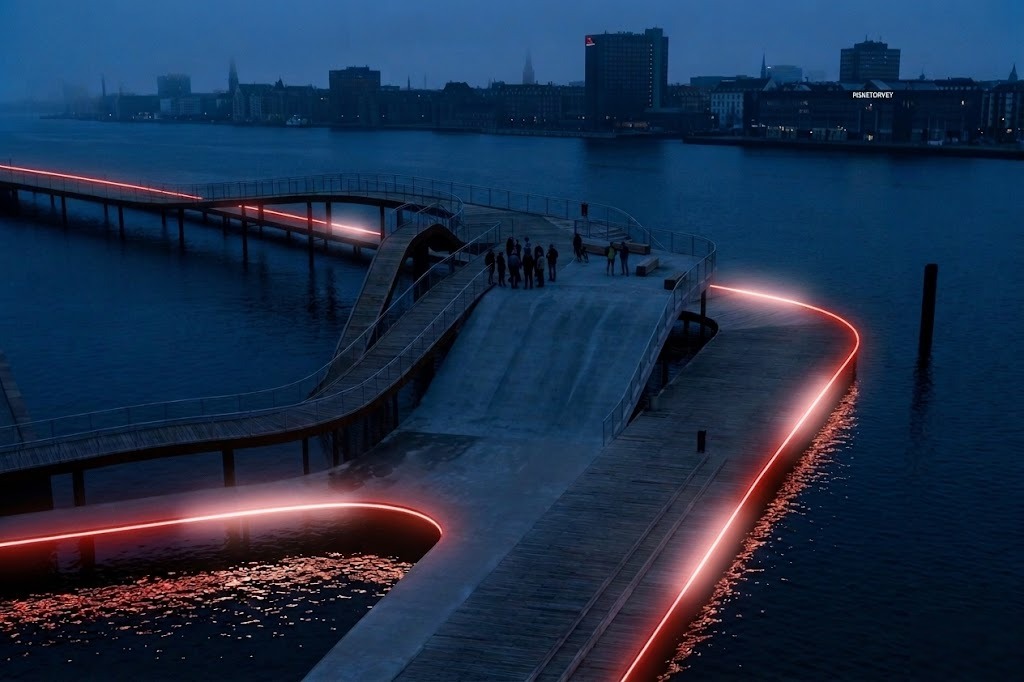
The piece has two distinct registers — one for people on the structure, one for people across the harbour.
A footstep, registered. As a visitor walks along the deck, the section of line beside them briefly brightens — a heartbeat pulse propagating outward along the 60 m of light.
Visitors walk onto the boardwalk and the line responds. Each footstep becomes a brighter pulse that travels outward in both directions — a heartbeat. Two people walking from opposite ends see their pulses meet and pass through one another. Children running send rapid trains of pulses cascading along the line. Stopping on the jetty, a visitor can watch their own absence: the line breathing with the harbour, undisturbed, until someone else walks onto the structure.
Seen from across the inner harbour — from Fisketorvet, from the canals to the west, or from boats passing through — the line reads as a single warm-red ribbon, sixty metres long, glowing on the water's edge with a soft reflection beneath it. The heartbeat pulses remain visible as bright glows travelling along the line, but the interactive layer recedes. What remains is a slow, breathing line of light over dark water.
For the visitor on the structure, the piece is a living instrument — the body becomes part of its rhythm. For the viewer across the harbour, it is architectural lighting that quietly refuses to be still. The same line, two ways into the same idea.
1D simulation of the proposed installation. The base wave packets travel continuously — the line is always alive. Click anywhere on either canvas to trigger a heartbeat pulse, or use the buttons below.
Plan view
Unrolled line · 60 m
Space = pulse · F = stream · R = clear. Record saves a WebM video to your Downloads.
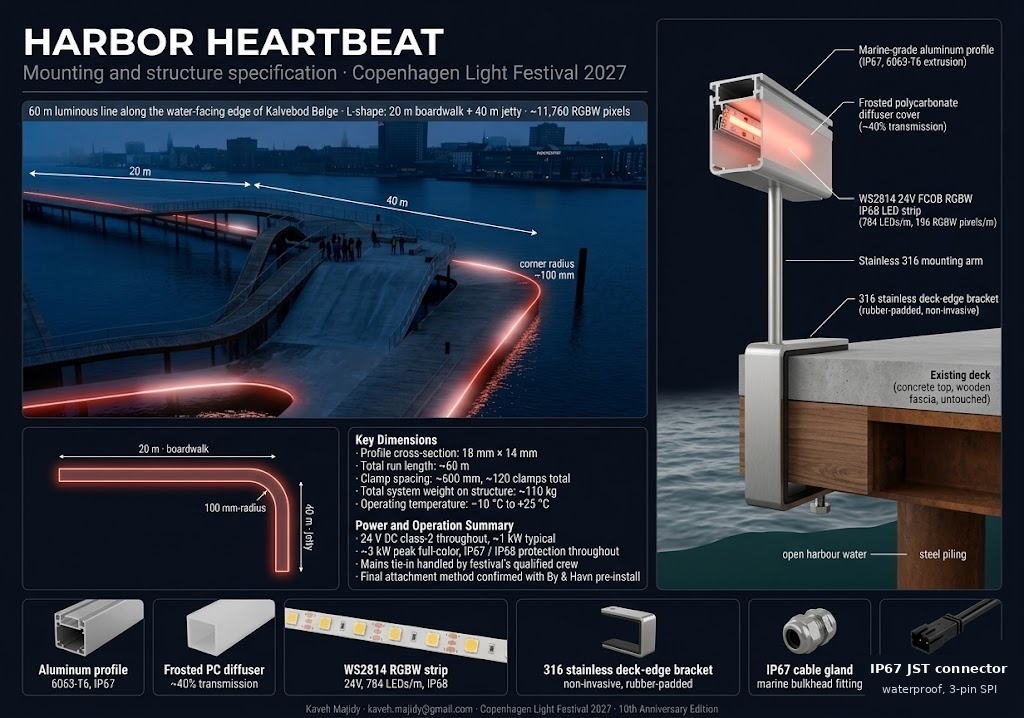
A summary of the build. Detailed cross-section, mounting bracket, and component sheet on the spec sheet linked below.
Lead Senior Software Engineer · Maker · Low-Key Artist · 17+ years of experience.
Software engineer based in Frederiksberg, Copenhagen, with a long-running personal practice in custom electronics, embedded firmware, sensor-driven systems, and homemade 3D-printed artworks. Harbor Heartbeat is my first public art installation — the piece extends a practice that has lived on screens and inside private rooms into shared, civic space.